When to Take Vitamins D and K: Why Dietary Fat Matters
Short answer: Vitamins D and K are fat-soluble, and MedlinePlus says they are absorbed more easily with dietary fat[1]. A meal that includes some fat is a natural pairing for both.
NAN HEALTH Editorial, updated October 22, 2026. 5 min read. How we write
 In this articleEssentials BundleYour daily foundation for sleep, bones, immunity and brain*
View →

Fat-soluble vitamins pair well with dietary fat
Timing questions about vitamins D and K start with how the body handles them. Both dissolve in fat, and that one fact explains most of what matters.
Vitamins A, D, E and K are fat-soluble, meaning they dissolve in fat rather than water. MedlinePlus[1] says the body absorbs these vitamins more easily when dietary fat is present.
The same page says the body keeps them in the liver, fatty tissue and muscles. Water-soluble vitamins, such as vitamin C, are not kept in the same way, so they have to come in more regularly.
Think of it like a salad dressing. Oil and water do not mix, and a vitamin that dissolves in oil travels best with oil. That is a simple picture, not a measurement, but it matches the principle MedlinePlus states.
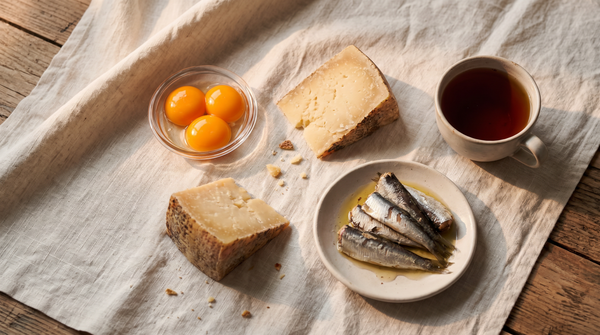
Food sources show the pattern. MedlinePlus lists[2] fatty fish, cheese and egg yolks as sources of vitamin D. Its vitamin K page[3] lists eggs, fish, liver and meat among smaller sources, so many of these foods bring some fat along.
The catch: The page states a general principle. It does not give a minimum amount of fat or a time of day.
What vitamins D and K do in the body
Vitamin D helps the body absorb calcium, which is needed for normal bone formation, according to MedlinePlus[2].* Supplements come as D2 (ergocalciferol) or D3 (cholecalciferol).
Vitamin K helps the liver make clotting factors, the proteins that let blood clot.* The same page[3] says some studies suggest it helps maintain bone strength in older adults.*
Both vitamins are fat-soluble, so the same fat pattern applies to each.
For the reasoning on how the two work as a pair, see Do You Need K2 With D3?
Reference amounts: MedlinePlus lists 600 IU (15 mcg) a day as the RDA, the official daily intake, of vitamin D for adults 19 to 70. For vitamin K, the Adequate Intake is 120 mcg a day for men and 90 mcg for women.
For reference, our vitamin D3 + K2 spray has 55 mcg (2200 IU) of vitamin D3 and 100 mcg of vitamin K2 per 1 mL serving.
What a trial of vitamin D with meals measured
A 2013 conference abstract reported a randomized trial that tested exactly this question for vitamin D. The authors compared taking it with the largest meal or after an overnight fast[4].
Who took part: 326 adults were randomized and 249 finished. Their starting vitamin D blood levels (25(OH)D, the usual blood marker) were between 10 and 30 ng/mL.
Daily dose: The lowest arm used 1,000 IU of vitamin D a day. Other arms went up to 4,000 IU a day of D3, and one used 50,000 IU of D2 once a week. These are study amounts, not advice.
What changed: After 12 weeks, blood levels rose from 23.0 to 36.1 ng/mL with food and from 22.7 to 34.2 ng/mL when fasting. In the 4,000 IU D3 group, the rise was larger with food: 13.7 versus 6.9 ng/mL.
The catch: The overall difference between the groups was not statistically significant. The clear gain appeared in one dose group, and the study was open-label, meaning participants knew how they took it.
Still, the direction fits the MedlinePlus principle. In the group with the highest daily amount, the meal made a visible difference to the blood level.
Why an oil-based format fits these vitamins
If fat helps these vitamins absorb, it is logical to look at what they are dissolved in. Some products deliver D and K in an oil, so the fat is already part of the format.
That is a reasonable design match, not a proven advantage. The trial above looked at meals, not at oil versus tablets, and no source here compares the two.
It also helps to think about habits. A vitamin that is easy to use at the same point in the day is easier to remember. Many people link it to a meal they already eat, and a meal with eggs, cheese, fish or nuts brings some fat along.
The fat does not need to be fancy. MedlinePlus names ordinary foods, such as egg yolks and cheese, as sources. Any meal with a bit of fat follows the same principle.
Steady habits matter as much as the clock
For vitamin K, steadiness has its own reason. MedlinePlus[3] says people taking the blood thinner warfarin need to keep vitamin K intake consistent from day to day, because sudden changes can alter how the medicine works. That is a question for a prescriber.
Fat-soluble vitamins are also kept in the body. Because of that, MedlinePlus[1] says large supplement amounts of A, D, E and K can build up and cause harm, so the amount matters more than the hour.
Vitamin D is also slow. Blood levels in the trial above changed over 12 weeks, not over a day, so the time of day is a small part of the picture.
For how fast results show, see How Long Until Vitamins Start Working.
Takeaway: Vitamin D and vitamin K are both fat-soluble, and both are absorbed more easily with dietary fat. That makes it logical to pair them with each other and with a meal that contains some fat, and an oil-based format fits a fat-soluble vitamin.
Who should be careful with timing and amounts
Timing is the easy part. The amounts matter more, and the right amount depends on the person.
Check with your doctor first if you:
- take a blood thinner such as warfarin, or any other medication (vitamin K can interact)
- have kidney disease or a history of kidney stones
- are pregnant or breastfeeding
- are giving supplements to a child
- have a health condition or have not had your vitamin D level checked
For reference, MedlinePlus[2] gives the upper limit for vitamin D as 4,000 IU (100 mcg) a day for ages 9 and up. Too much vitamin D can raise blood calcium.
Read next
References (4)
References
- MedlinePlus, National Library of Medicine: Vitamins (fat-soluble vitamins)
- MedlinePlus, National Library of Medicine: Vitamin D
- MedlinePlus, National Library of Medicine: Vitamin K
- ACR/ARHP Annual Meeting, 2013: A prospective randomized open-label trial to evaluate the effect of food on vitamin D absorption (conference abstract)